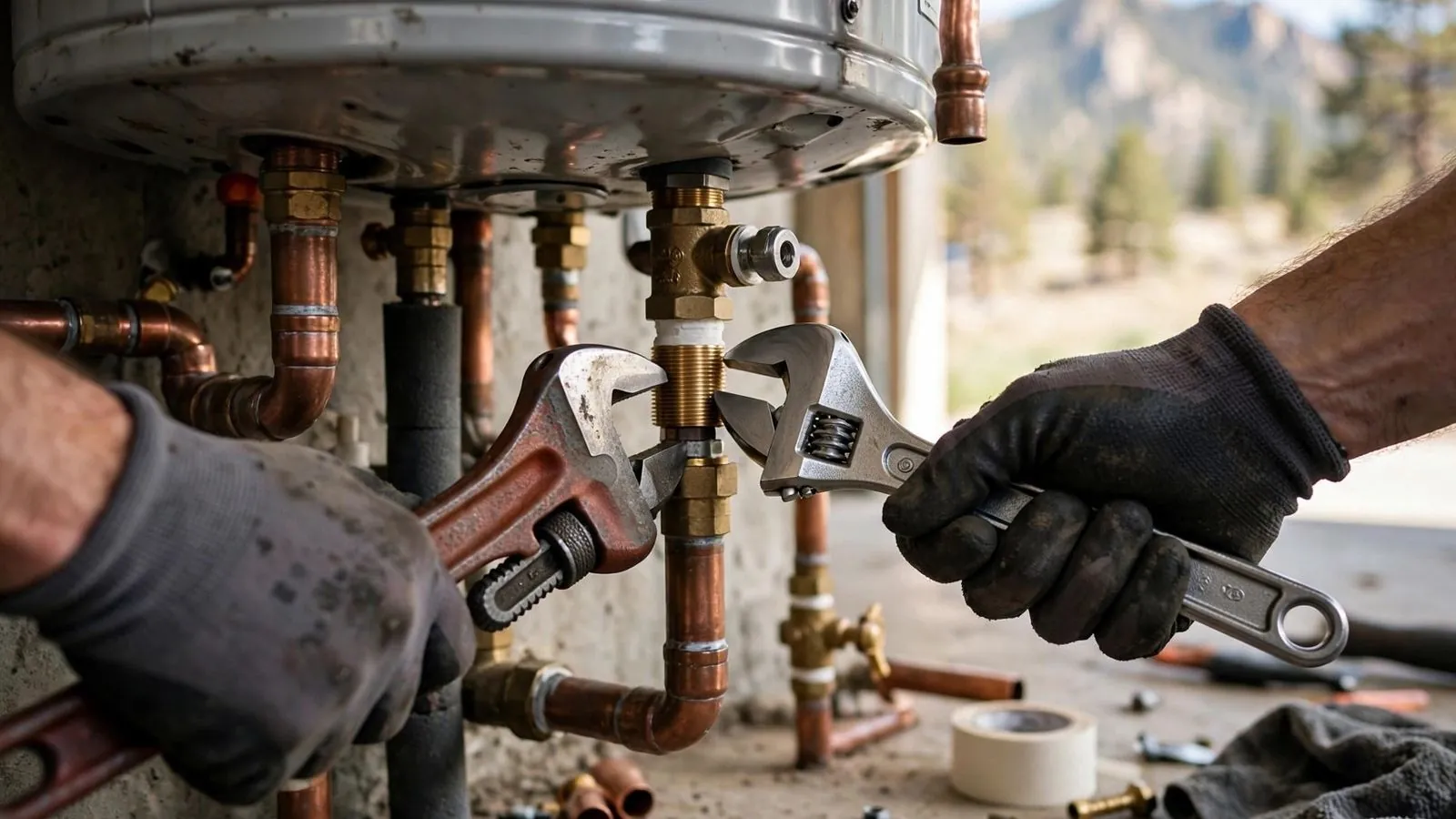
Emergency Water Heater Repair in American Canyon, CA
A leaking tank, a dripping valve or a heater that went cold: we find the real source before anything gets replaced.
A water heater leaking onto the garage floor or into a closet pan needs attention within minutes. Water heater repair in American Canyon, CA starts with one question: does the water come from the tank shell, a fitting or the relief valve? We answer the phone 24/7 and dispatch a licensed plumber, with same-day appointments when available. A loose connector is a short job, and a rusted-through tank is not a repair at all.
While you wait, three moves limit the damage no matter what is leaking. Close the cold supply to the heater, shut off its fuel or power, and clear anything valuable off the floor. The rest of this page explains what each kind of leak means, what to check when the water simply runs cold, and how gas, electric and hybrid models differ.
Water is pooling around the heater right now
Standing water under a heater is both a property problem and a safety problem. The water may be scalding, the floor may be slick, and an electric unit sitting in a puddle is a shock risk. Work in the order below and stop at any step that feels unsafe.
A steady drip into a bucket buys you time, but a fast stream does not. If the pan is overflowing or water is moving toward a wall, treat it as an active flood and call right away.
- Smell gas at any point? Leave the house first and do not touch light switches, lighters or anything that could spark. Call 911 from outside, then PG&E, the gas utility for most of the North Bay, at 1-800-743-5000.
- Shut off the fuel or power. On a gas heater, turn the control knob to off. On an electric one, switch off its breaker only if you can reach the panel without stepping through water.
- Close the cold water supply valve on the pipe entering the top of the heater. Turn the handle until it stops, or a quarter turn for a lever.
- Stay clear of the pipe that runs from the relief valve down toward the floor. Water from it can be hot enough to scald.
- Move boxes, tools and anything stored on the floor out of the water, and photograph the damage before cleanup for your records.
- Call (855) 575-2890 and tell the dispatcher the tank size if you know it, whether it is gas or electric, and exactly where the water is showing up.
Tank, fitting or relief valve: reading the puddle
Most callers describe the same scene: water on the floor, a heater that still seems to be working, and no idea where the water starts. The location of the wet spot narrows it down quickly. Water on top of the tank usually points to the pipe connections or the anode rod port, while water at the bottom could be almost anything that ran down the side.
Fittings are the best case. The flexible connectors, the union nuts and the shutoff valve above the heater all loosen or corrode over the years. Tightening or replacing one of them is a modest repair, and the heater keeps working afterward.
The relief valve is the second case. It is a safety device, and it opens when pressure or temperature climbs too high. A valve that drips once in a while may just be worn, but one that runs steadily often means pressure in the house plumbing is spiking, and swapping the valve alone will not cure that.
The tank shell is the bad case. If water seeps from the seam, from the jacket at the bottom or from under the insulation, the steel liner has failed. That heater is finished, and the honest next step is a conversation about replacing the water heater rather than paying for a repair that cannot hold.
Talk through water heater repair at your address. Call (855) 575-2890 and a licensed plumber can be dispatched.
(855) 575-2890What the symptom usually means
Use this as a starting guide, since only a hands-on inspection confirms the cause.
| What you see | Likely cause | What the repair involves |
|---|---|---|
| Wet pipes and fittings on top | Loose or corroded connector or shutoff | Tighten or replace the fitting, then pressure check |
| Water from the pipe by the relief valve | Worn valve or high house pressure | Replace the valve, then test pressure and thermal expansion |
| Seeping seam or wet insulation | Tank liner has failed | No repair is possible, so plan a replacement |
| Rust-colored water and rust streaks | Corroded tank or spent anode rod | Inspect the rod, and replace the tank if the shell is gone |
| Rain-like drip from the flue area | Condensation or a leak above | Trace the source before touching the heater |
| Water in the drain pan, tank dry outside | Leak from a nearby line or the pan itself | Follow the line back to the actual source |
A wet floor does not always mean a heater problem. Supply lines and appliances nearby can drip into the same pan.
No hot water, or hot water that quits halfway
A heater that has simply gone cold is a different call from a leak, and often a cheaper one. The cause depends on the fuel, and some of it you can check safely before dialing.
Do not remove covers or panels from a gas unit, and do not relight a pilot if you have smelled gas. For anything beyond the checks below, call and we will take it from there.
- Electric: look for a tripped breaker, which can point to a failed heating element or thermostat.
- Gas: check whether the control shows a fault light or code, and write down what it says for the dispatcher.
- Water runs warm, then cold within minutes: a failed element, a broken dip tube or heavy sediment in the tank.
- Water is hot but weak at every tap: that points to the house plumbing rather than the heater.
- Water is scalding hot: the thermostat or gas valve may be failing, so turn the setting down and call.
Why a rusty tank cannot be patched
Inside every steel tank is a glass-like liner, and a sacrificial anode rod that corrodes first so the tank does not. Once the rod is used up, the steel begins to rust from the inside, slowly at first. Weeping at the seam and brown streaks down the jacket are the late signs.
If the tank is still sound, replacing a spent anode rod can extend its life, and we will say so honestly. If the shell has already rusted through, nothing from outside the tank will seal it. At that point it makes more sense to plan a new unit's installation than to keep paying for repairs.
Gas, electric and hybrid water heater repair compared
Gas heaters add the burner, the pilot or igniter, the thermocouple and the gas control valve to the list of things that fail. They also add a flue, which has to draw properly to carry exhaust out. Anything involving gas parts or venting is licensed work, and a smell of gas always overrides every other step on this page.
Electric heaters are simpler. Two heating elements and two thermostats do most of the work, and most no-hot-water calls come down to one of those parts. They have no flame, but they do need the power off before anyone opens a panel.
A tankless unit is a different animal, covered on the tankless water heater page. Hybrid or heat pump models combine an electric element with a compressor that pulls heat from the surrounding air. They have more parts, a condensate drain and an air filter that needs attention. If you own one, give the dispatcher the model number when you call so the right technician is sent.
How a repair visit unfolds
Find the source
The plumber dries the area, checks each connection and watches where the water reappears.
Test the system
Water pressure, the relief valve and the heating components are checked so one fix does not hide another problem.
Explain the options
You hear what is repairable, what is not, and the price of each route, before any work begins.
Fix and verify
After the repair, the heater is refilled, brought back up to temperature and rechecked for drips.
What shapes the price of a water heater repair
Two heater repairs on the same street can cost very different amounts, and these are the reasons.
A connector or relief valve is a small job. An element, thermostat or gas control valve takes more time and a more expensive part.
Gas work involves venting and gas parts, and hybrid units involve compressor-side components, so each adds its own labor.
A heater in an open garage is quick to reach. One tucked into a tight closet or an attic platform takes longer.
Corroded shutoffs and fittings can break when touched, which may turn one repair into several.
Late-night and weekend dispatch is priced differently from a planned daytime visit, and you hear the number first.
Many homeowner policies cover sudden and accidental water damage, such as a tank that bursts, but not a slow leak or a worn-out heater itself. Policies differ, so ask your insurer what applies, and photograph the damage before any cleanup begins.
You get a clear price before work starts, and the fastest way to get the real number for your home is to call (855) 575-2890.
When the leak is the city's, not your heater's
If water is surfacing at the street, the meter or the sidewalk rather than inside your garage, the problem sits on the city side. The City of American Canyon takes water leak reports at (707) 647-4364, and after hours, weekends and holidays at (707) 995-8674. A call to them first saves you paying for a visit that cannot fix a city main.
If the water is clearly coming from your own plumbing, or you cannot tell, call us and we will find out. The heater's own cold supply valve is the quickest way to test it: close that valve, and if the puddle keeps growing, the source is somewhere else. We also work in Vallejo and other nearby towns, so a heater on either side of the county line gets the same approach.
Water Heater Repair questions from American Canyon homeowners
Yes. Water does not wait for business hours, so the line is answered at any hour and a licensed plumber is dispatched for active leaks. A tank pouring water at 2 a.m. on a Sunday gets the same triage as a Tuesday afternoon call, and you hear the price before work starts. If the leak is slow, we may suggest shutting the supply valve and booking the next available appointment instead.
Water at the top usually comes from the pipe connections, the shutoff valve above the heater or the anode rod port, and it runs down the sides, which makes the tank look like the culprit. These leaks are often repairable. Dry the top with a towel and watch where fresh drops appear, then give that detail to the dispatcher.
An occasional drip when the heater is firing can be normal expansion, but a steady stream is not. It may mean the valve is worn or that house water pressure is too high. Never cap or plug that pipe, since the valve is there to prevent a pressure failure. Have it checked, and we can test the pressure at the same time.
On an electric heater, check the breaker first. On a gas heater, look for a fault light or code and note what it shows. Do not open panels or relight a pilot yourself, especially if you have smelled gas. Many no-hot-water calls turn out to be a heating element, thermostat or igniter, which is a straightforward repair.
Usually not. Water from the bottom of the tank shell means the inner steel has corroded through, and no outside patch holds against a full tank. We confirm it first, because a leaking fitting nearby can look the same. If the tank is the source, we explain the replacement options, and you decide with a clear price in hand.
Give the dispatcher the make and model number when you call, and they can tell you whether a technician can handle it. Hybrid units share the plumbing side with ordinary tank heaters, but they have a compressor, a filter and a condensate drain on top of that. We will be straightforward if a repair is better left to the manufacturer's channel.
Yes, once the heater is refilled and purged of air. Run a hot tap for a minute or two to clear sputtering, then check taps for steady flow. If the water ran brown or rusty before the repair, tell the plumber, because that may indicate sediment or a tank that is near the end of its life.
Ready to talk through water heater repair at your home?
(855) 575-2890Water Heater Repair. Source note: California Health and Safety Code section 19211 requires water heaters to be braced, anchored or strapped against earthquake motion. Plumbing work follows the California Plumbing Code (Title 24, Part 5), the state standard for plumbing.