Tankless Water Heater in American Canyon, CA
Cold bursts, long waits and blinking error codes all have causes we can trace, flush or replace.
A tankless water heater is supposed to deliver hot water for as long as you need it, which makes it frustrating when it does not. Tankless water heater service in American Canyon, CA covers flushing scale, diagnosing faults, repairing parts and replacing units that are past saving. A tankless unit heats water on demand and stores none, so when it struggles, you notice at the tap.
Some callers learn that plumbing companies they phone do not touch tankless units at all. We flush, repair and replace them, and we say so plainly. The page below starts with the symptoms, then moves through descaling, a decision table and what service or replacement looks like.
The hot water runs out, turns lukewarm, or takes forever to arrive
If the shower goes cold halfway through, the faucet needs a long wait before it warms or a display flashes a code, the heater is telling you something specific. The cause is usually one of a handful of problems, and the symptom points to which one. That is what a tankless water heater diagnosis is: matching the symptom to the failure.
A fading flow of hot water often means the heat exchanger is coated with mineral scale, so water cannot absorb heat quickly. Lukewarm water that never quite gets hot can mean the unit is undersized for the demand, a sensor is misreading or the gas supply is restricted. A long wait for hot water at a faraway faucet is usually distance and pipe volume, since a tankless unit starts heating only when flow begins.
Error codes are the unit's own diagnosis, and they differ by manufacturer. Write down the exact code and the model number before you call, since the dispatcher can use both to plan the visit. Do not open the cabinet of a gas unit yourself.
Tankless flush and descale, and why scale builds up
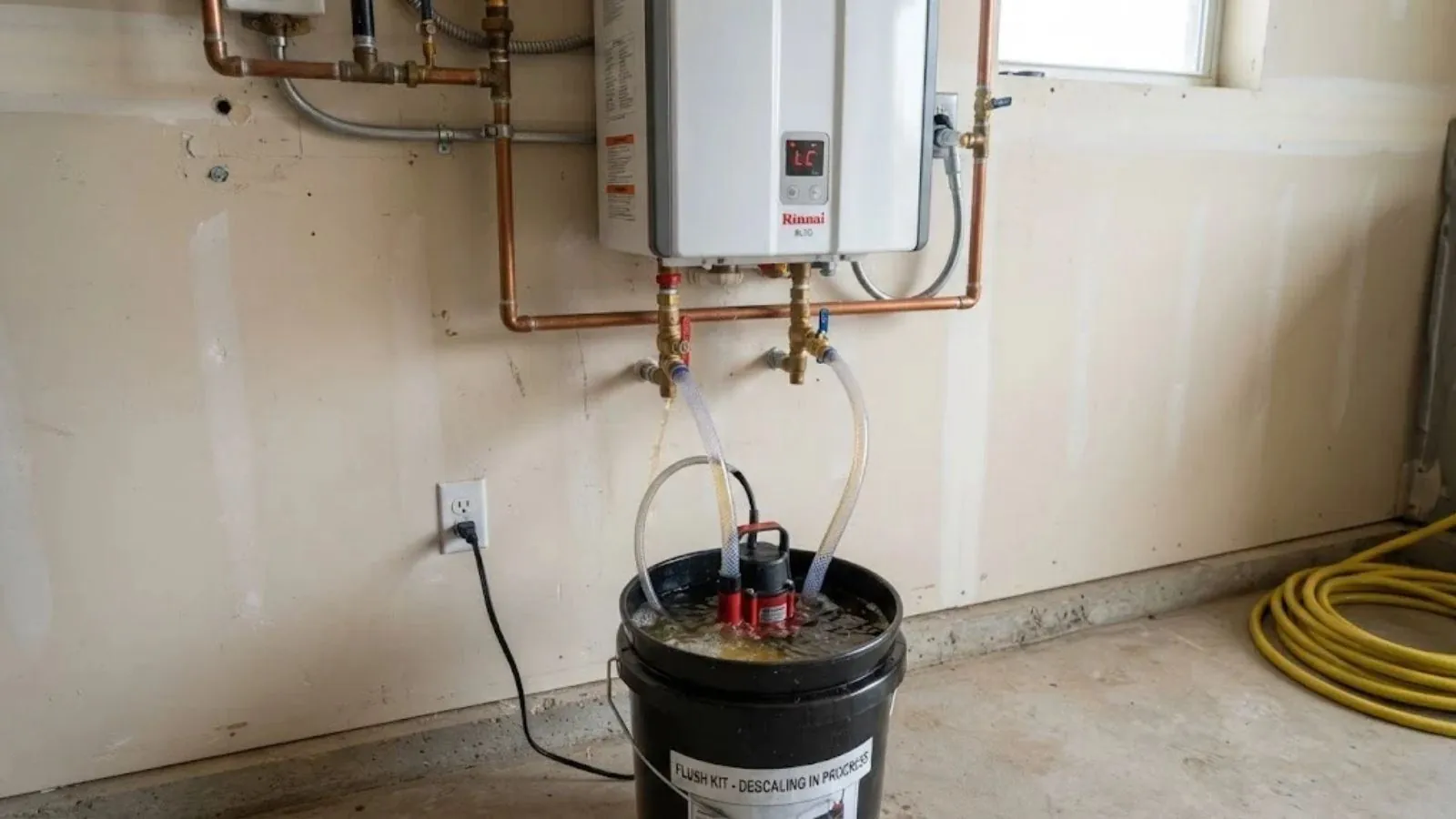
Every time the unit heats water, dissolved minerals can cling to the heat exchanger. Over months, that coating narrows passages and forces the unit to work harder for the same temperature. Flushing is the maintenance step that clears it out.
A flush circulates a descaling solution through the unit with a pump, then rinses it with clean water. It also lets the technician clean the inlet filter screen and look over the connections. The work is done through the isolation valves, so a unit installed without those valves needs them added first.
- Signs it is due: a drop in hot water temperature, a noisy burn or louder hum, longer waits, or a code that points to a flow or temperature fault.
- The longer scale builds, the harder flushing becomes, and heavy buildup can damage the exchanger.
- Flushing does not fix a failed part. It clears a clogged one, which is why a diagnosis comes first.
- Ask us how often your particular unit should be flushed, since manufacturers publish their own schedules.
Talk through tankless water heater at your address. Call (855) 575-2890 and a licensed plumber can be dispatched.
(855) 575-2890American Canyon water and what it means for scale
The City of American Canyon's 2023 water quality report lists total hardness averaging 92 ppm, with a range from 60 to 188 ppm. In practical terms, that is moderate hardness: scale does form, but more slowly than in places with harder water. For a tankless owner, that means flushing is worth doing on a regular schedule, not panicking over.
Your own number can sit anywhere in that range, and a few addresses are served by Vallejo's system instead, so check your water bill. Ask for the exact figure from the city's annual report, and bring it to us if you are deciding how often to flush. If you live just south in Vallejo, ask Vallejo Water for its hardness figure instead.
Symptoms, likely causes and the usual fix
A tankless diagnosis starts with the symptom, and this table shows common pairings.
| Symptom | Likely cause | What usually helps |
|---|---|---|
| Hot water fades over a few minutes | Scale on the heat exchanger | Flush and descale the unit |
| Water stays lukewarm at every tap | Sensor fault, restricted gas or undersized unit | Diagnostic testing, then repair or resizing |
| Cold burst between hot water | Low flow or a short demand pattern | Check minimum flow, filter screens and fixtures |
| Error code on the display | Varies by model and brand | Read the code, then test the related part |
| Unit will not ignite or start | Gas, power, vent or igniter problem | Inspection and repair, never DIY on gas |
| Leak at or under the unit | Loose connection or failed internal part | Shut the supply and call for repair |
Never relight, open or adjust a gas tankless unit on your own. If you smell gas, leave, call 911, and then call PG&E at 1-800-743-5000.
Do you service tankless units, or only replace them?
Plenty of homeowners are told by one company or another that tankless heaters are out of their scope. We handle all three jobs: flush, repair and replace. Servicing is often the right first step, because many tankless problems come from scale, filters, flow or a single part.
Replacement is the answer when the heat exchanger has failed, when scale damage is severe, when repair parts would cost more than the value left in an aged unit or when the unit was never sized properly. The honest call depends on the diagnosis, and we explain the trade-off before work starts. If a conventional tank is also on your list, water heater repair shows how repairs differ on that type.
Tankless install questions worth settling early
Fitting a tankless unit into a home built for a tank is more than a swap. The gas line often has to carry more volume, the venting usually changes and electric models need a substantial circuit. Sizing depends on how many fixtures run at once and how cold the incoming water is.
If you are planning one, read water heater installation for the general planning points, and ask the City of American Canyon building division whether your particular job needs a permit. Permit rules vary, so do not rely on a neighbor's experience.
What a tankless service visit includes
Symptoms and codes
You describe what is happening and share any code the unit has displayed.
Inspect the system
The technician checks the flow, the filters, the venting, the gas or power supply and the isolation valves.
Flush or repair
If scale is the issue, the unit is flushed. If a part failed, it is replaced and tested.
Test and explain
The unit is run through a full heating cycle, and you hear what was found and when to schedule maintenance.
What affects the price of tankless service
Tankless work varies by brand and by what is wrong, so these are the biggest drivers.
A flush is a maintenance job. A failed circuit board, sensor or heat exchanger is a repair with parts.
Parts availability and complexity differ widely between makes, which affects both cost and time.
A unit that has never been flushed needs more time to clear, and badly scaled ones may not recover.
If the unit lacks service valves, they need to be added so that flushing is possible.
Any adjustment to the gas line or the vent adds licensed labor and parts.
Insurance usually does not pay for maintenance like flushing or for wear on an older unit. Sudden damage from a burst or leaking unit may be covered, but policies differ, so ask your insurer and photograph any water damage before cleanup.
For a clear price before work starts on your unit, call (855) 575-2890 with the brand, model and any code on the display.
Before you call about a tankless unit
A few details make the call faster and the visit more useful. None of them involve opening the unit.
- The brand and model number from the label on the front or side.
- Any code or light pattern showing on the display.
- Whether the problem happens at every tap or just one.
- When the unit was last flushed, if you know.
- If you have a water softener or filter installed, which is covered under water softener and filtration.
Tankless Water Heater questions from American Canyon homeowners
Usually the unit is struggling to keep up. Scale on the heat exchanger, a clogged filter screen, low flow through the unit or too many fixtures running at once can all cut the heat. It can also be a sensor or ignition fault. Give the dispatcher the brand, the model and any code, and we will work out which it is.
Manufacturers publish their own schedules, so check your manual first. Water in American Canyon is moderate in hardness, so scale builds slowly, but not never. Ask for the exact hardness figure in the city's annual report, then adjust your schedule to it. A unit with heavy use or a softener-free setup may need attention sooner.
We flush, repair and replace them. Some companies decline tankless work, but we handle it. A diagnosis comes first, and if repair makes sense, we say so and give a clear price before work starts. If the unit is beyond saving, we tell you that too and discuss replacement options.
Codes differ by manufacturer, and the same number can mean different things on different brands. Many point to a flow, ignition, venting or temperature problem. Write down the exact code and the model, and do not open a gas unit. We use the code as a starting point and then test the related components.
It depends on your household, your gas or electric supply and how the house is plumbed. Tankless models save space and avoid a standing tank, but installation can require larger gas lines or new venting. Our installation page covers the planning points, and we can talk through your home when you call.
A tankless unit begins heating when water starts moving, and then the hot water has to travel through the pipes to your faucet. The farther the tap, the longer the wait. Low flow can also keep the unit from firing. A diagnosis can tell whether it is distance, a minimum-flow issue or a fault.
Ready to talk through tankless water heater at your home?
(855) 575-2890Tankless Water Heater. Source note: California Health and Safety Code section 19211 requires water heaters to be braced, anchored or strapped against earthquake motion. Plumbing work follows the California Plumbing Code (Title 24, Part 5), the state standard for plumbing.