How to Install a Garbage Disposal in a Single Sink (and When to Hand It Off)
Step-by-step guide to installing a garbage disposal in a single kitchen sink, with safety stops for power and drains.
A single-sink disposal install is a manageable weekend job when you already have an outlet under the sink and a drain that lines up. The work is mostly mechanical. You remove the old sink strainer, mount the new disposal, connect it to the drain trap, and test for leaks. The electrical side is where careful homeowners stop and call a pro.
The steps below are written for a swap or a first install with an existing outlet. If you hit any of the stop signs, garbage disposal installation and repair is a call away, and bigger sink or drain changes fall under plumbing installation.
Check these four things before you buy a unit
Most failed DIY installs go wrong before the first wrench turns. The unit may not fit, or the outlet may not exist. Spend ten minutes under the sink with a flashlight first.
- Is there a switched outlet or a nearby outlet under the sink, or is there only a bare wall box?
- Does the cabinet have room for the disposal, which hangs lower than the sink bowl?
- Is the drain pipe in good shape, with no corrosion or loose slip nuts?
- Does the dishwasher connect to this sink? If so, you will connect its drain hose at the disposal.
Tools and parts that make the job go smoothly
You need a screwdriver set, adjustable pliers, a bucket, a flashlight, plumber's putty, a cloth, and a hacksaw for trimming pipe if the new outlet sits at a different height. A non-contact voltage tester is worth owning for this job.
Buy the mounting kit that matches your unit. Most disposals ship with a sink flange and gasket. A power cord kit is a separate item if the unit has no plug, and wiring one in is the point where we suggest hiring an electrician.
Not sure which case applies to your home? Call (855) 575-2890 and describe what you see.
(855) 575-2890Power first: breaker off, then test
Turn off the circuit breaker that feeds the sink outlet, not just the wall switch. Then confirm the outlet is dead with a non-contact voltage tester. Do not trust a label on the panel, since labels are often wrong.
If you find a cable with bare wires and no outlet, or you cannot tell which breaker controls the circuit, stop. That is licensed electrician territory. A disposal draws real current, and a bad connection under a wet sink is a hazard.
Install in six moves
Clear and disconnect
Empty the cabinet, put a bucket under the trap, and loosen the slip nuts. Let the water in the trap drain out.
Remove the old strainer
Unscrew the mounting ring under the sink, push the strainer up through the hole, and scrape off old putty.
Seat the new flange
Press a rope of plumber's putty under the new flange, set it into the drain hole, and tighten the mounting assembly from below until it is snug.
Hang the disposal
Lift the unit, line up its mounting ears with the ring, and twist until it locks. Support it as you go, since it is heavy.
Connect the drain
Attach the discharge tube to the trap, using a new gasket. If a dishwasher hose is used, knock out the plug inside the inlet first.
Restore power and test
Turn the breaker on, run cold water, flip the switch, and check every joint for drips. Tighten slightly if any weep.
After the first run: what normal and not normal look like
A new disposal hums, grinds, and quiets down once the scraps are gone. A little vibration is normal. A steady drip at any joint is not, and neither is a grinding noise with nothing in the chamber.
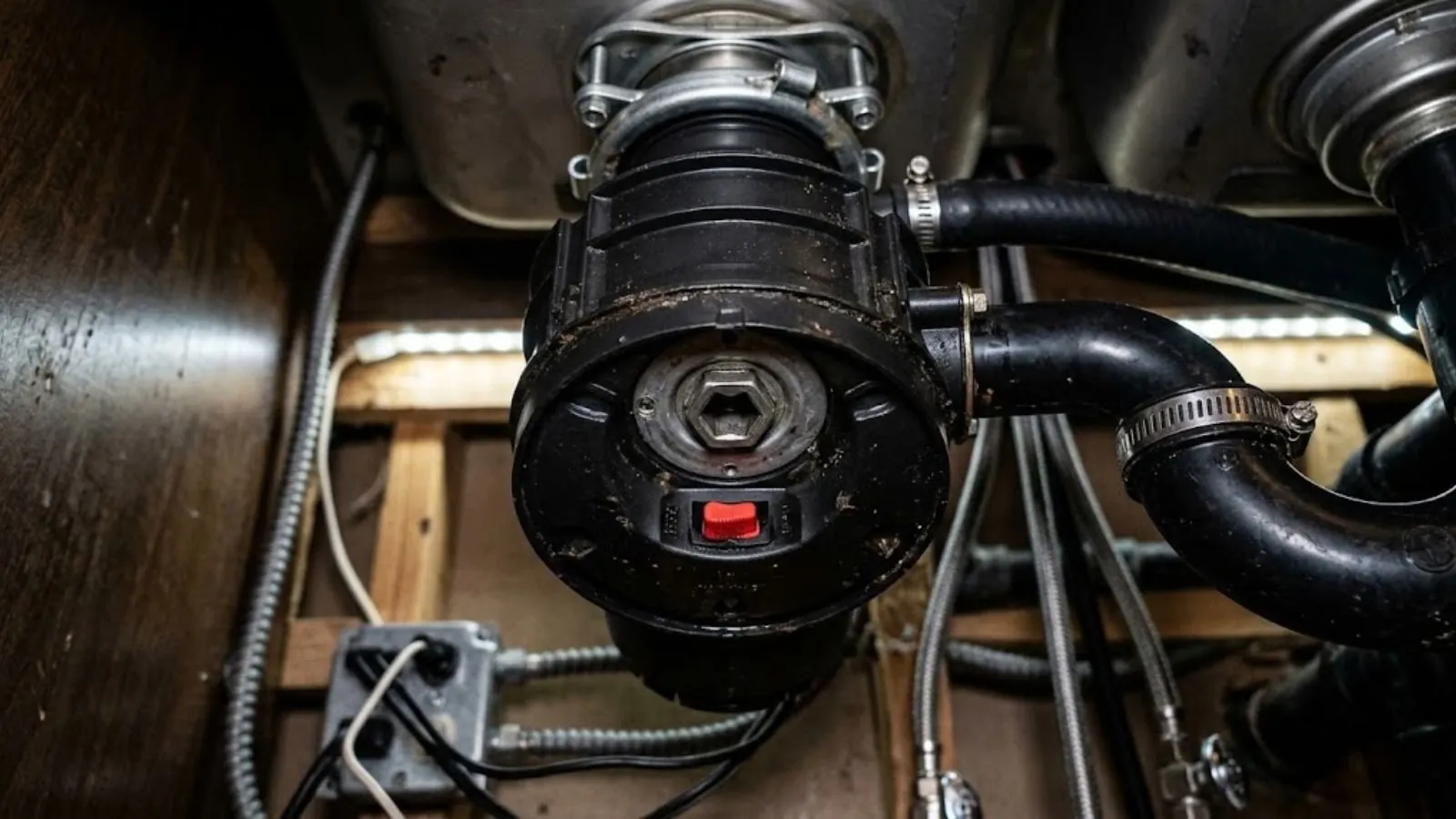
If it hums and will not spin, turn off the breaker before doing anything. Many units have a hex socket at the bottom for turning the plate by hand with a wrench, and a reset button on the underside. If the reset trips again right away, there is a fault, and the unit needs a professional look.
If water backs up into the second side of a double sink or into the dishwasher, stop the job. The drain may be partly blocked beyond the trap. A cleaning is the right fix, and our drain cleaning service handles that.
The knockout plug nobody warns you about
If your dishwasher drains into the disposal, there is a thin plastic plug inside the dishwasher inlet. It must be removed with a screwdriver and hammer before the hose is connected. Forget it, and the dishwasher will not drain.
Fish the loose plug piece out of the grinding chamber. Leaving it there can jam the unit the first time it runs, and the problem hides until the dishwasher fills the sink with dirty water.
Stop signs: hire it out when you see these
Know the limits of a weekend project. These situations should not become a learning experience.
- No usable outlet or switch under the sink, which means new wiring.
- A drain that has to be moved, resized, or re-routed through the wall.
- Corroded or leaking supply lines, shutoff valves, or drain piping.
- A slow drain that stays slow after the install, which points to a clog further down.
- Any smell of gas or sign of water near wiring.
What affects the cost of having it done
A straightforward swap with a working outlet is the simplest job. The unit itself varies by motor size and features, and a larger motor handles tougher scraps. Labor rises when the drain needs reworking or a new outlet is needed.
Access matters too. A cramped cabinet with a filter system or a water softener lines in the way takes longer. We give a clear price before work starts, so you know the cost before you commit.
What disposals do not like
Keep grease, coffee grounds in bulk, fibrous stalks, and stringy peelings out. Run cold water before, during, and after use. Never put your hand inside, even with the power off at the switch, and use tongs to retrieve a dropped item.
Many people in Napa and Vallejo ask whether a disposal is bad for the sewer. Used properly, it is fine. Heavy grease is the real enemy, because it cools in the pipe and builds up.
American Canyon note: permits and the sewer connection
Permit rules vary, so ask the City of American Canyon building division whether your job needs one. A simple unit swap may not be treated like a drain rework, but the city decides, not us. If you plan to alter the drain line, ask before you cut.
Title 14 of the American Canyon Municipal Code covers sewer and sanitation. Section 14.12.090 requires a permit to alter or repair a public sewer, side sewer, or building lateral. A disposal itself does not touch the lateral, yet any rework that heads that direction is a reason to call the city at (707) 647-4360 first.
Source type: American Canyon Municipal Code Title 14, section 14.12.090.
Common questions answered
If the outlet is already in place and the drain lines up, many homeowners can. Turn the breaker off, confirm with a voltage tester, and follow the steps above. Hire a pro for new wiring, drain rework, or any leak you cannot stop.
Yes if there is no outlet under the sink or if the unit must be hardwired. Wiring is not a casual DIY task. Even with a plug-in unit, shut off the breaker at the panel and test the outlet before you touch anything, since a wall switch alone does not isolate the circuit.
It varies by cabinet access and whether the old unit fights you. Allow a few hours if you are doing it the first time. Rushing leads to leaks, so check every joint again after twenty minutes of use.
A leak at the bottom of the unit can mean a cracked housing or a failed seal. Do not run it. Turn off the breaker, empty the cabinet, and call us on (855) 575-2890. Our disposal repair and installation page lists common causes.
Yes with normal food scraps and cold running water. Grease, large amounts of starch, and fibrous waste cause clogs. If your sink drains slowly after install, stop using the disposal and have the drain checked.
Permit rules vary, so ask the City of American Canyon building division at City Hall, 4381 Broadway, Suite 201. A like-for-like swap is simpler than moving drains or wiring, but the city makes that call. Ask before you start any change to the drain line.
Want a plumber to look at it?
(855) 575-2890About this guide. Source note: plumbing work in California follows the California Plumbing Code (Title 24, Part 5), the state standard. You can verify any contractor with the Contractors State License Board at cslb.ca.gov.